
The Magic of Borrowed Chords Explained
Chord progressions can make or break a song. Despite this fact, many songwriters often have trouble coming up with interesting chord progressions. They get stuck using the same old sequences over and over again.
Fortunately, there is an easy solution to help spice up your chord progressions, and that’s to use borrowed chords. In this article, you’ll learn what borrowed chords are, how to use them, and study examples of borrowed chords in famous songs.
This article is a summarised transcript of our video “Borrowed Chords Explained: A Simple 2-Step Method for Songwriters”. Click here to watch the video for more details, explanations and examples.
Understanding the Diatonic System and Basic Chord Progressions
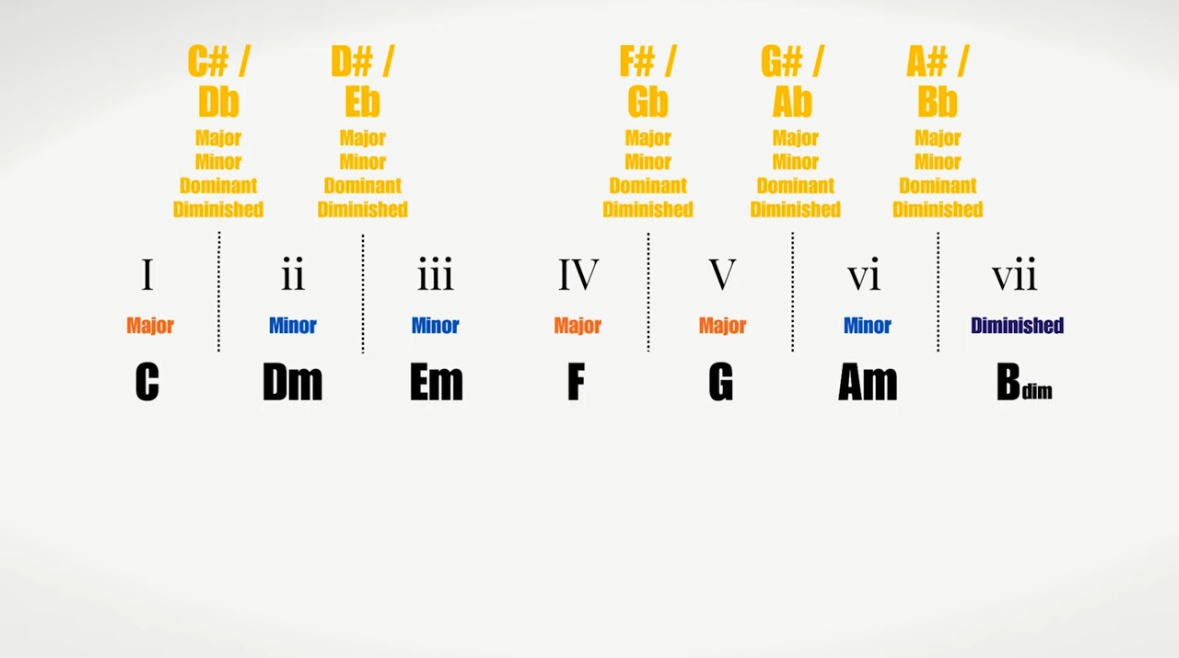
Before we learn how to use borrowed chords, we must first understand the diatonic system, and how to construct basic chord progressions. A diatonic system refers to how the chords are arranged inside a major key. Below is an example using the chords in the key of C Major:
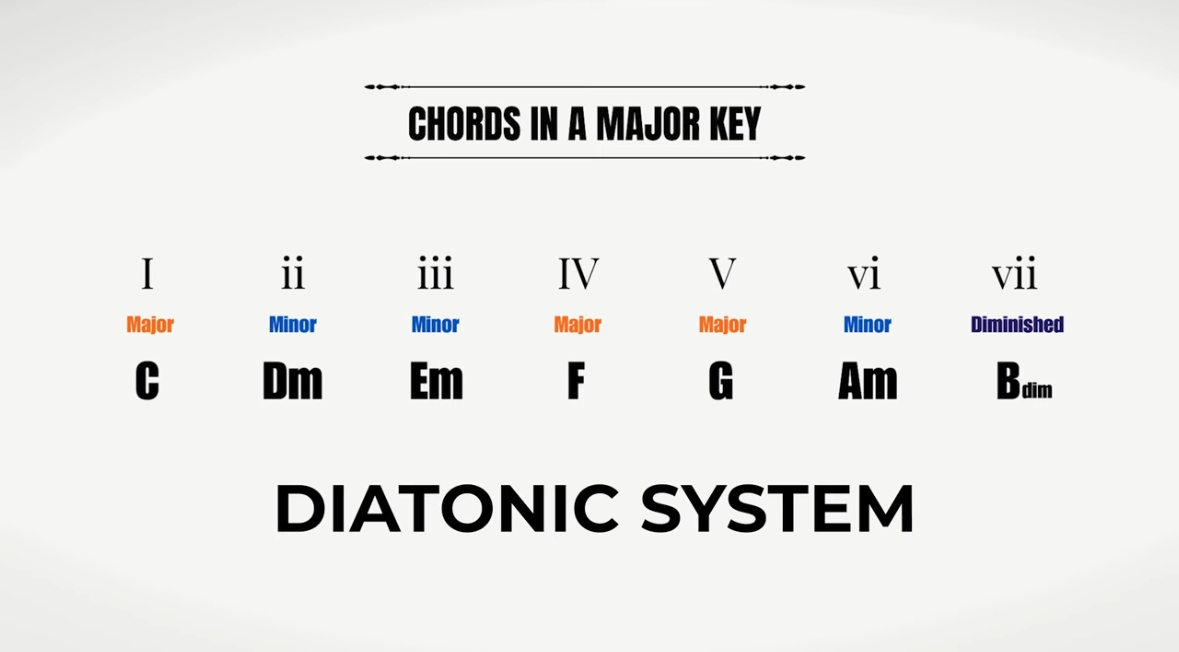
An important thing to note is that the upper case Roman numerals refer to Major chords, whilst the lower case Roman numerals refer to Minor chords. This arrangement of Major – Minor – Minor – Major – Major – Minor – Diminished will be the same for all 12 keys in Western music.

Although you could use a combination of any number of diatonic chords to create a progression, we must be selective about the order we place them in. Otherwise, the progression will sound random, and aimless.
To do this, we must split the chords into two types i.e. “Home” and “Away”. The “Home” chord always refers to the I chord or the tonic of the key. All other chords in a key are considered “Away” chords. The goal of chord progressions is to create tension and resolution using “Home” and “Away” chords.
When we use an “Away” chord, we create tension. On the other hand, the “Home” chord creates resolution. You can prolong the resolution by stacking more “Away” chords before your “Home” chord. By lengthening the resolution, you therefore increase the tension.
Jumpstart your songwriting by downloading our free 14-page PDF containing step-by-step breakdowns of the chord progressions to well-known songs here:

Step 1 of Borrowed Chords: Change the Quality
A great way to incorporate borrowed chords into your progressions is to change the quality of the chords in a diatonic system. By changing the quality of the chord, we’re referring to changing the type of chord. Below is an example of the chord options that would open up in the key of C Major if we applied this principle:
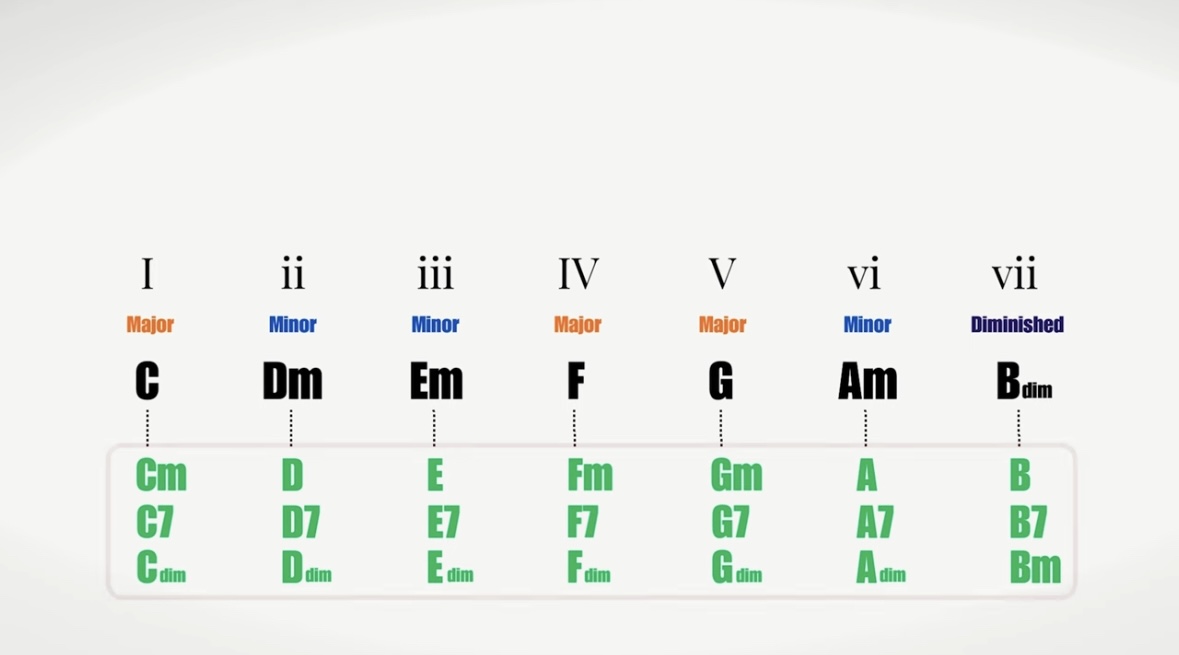
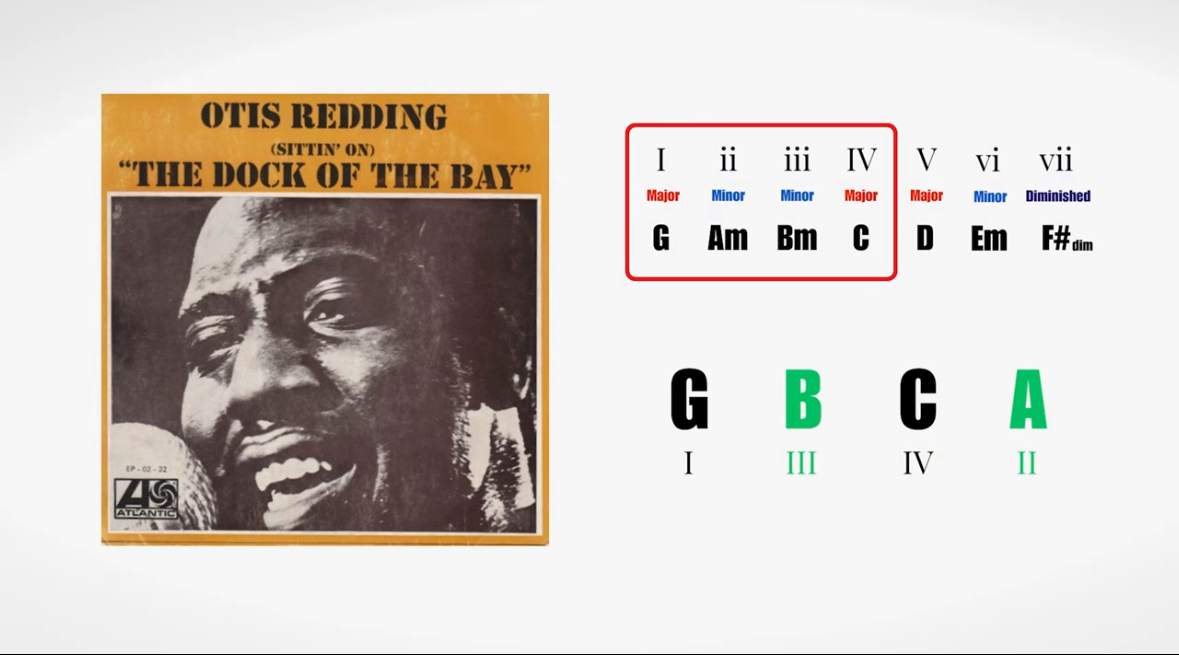
A great example of a song that uses this method is “The Dock of the Bay” by Otis Redding. In this song, the III and II chords have been changed from minor to major. By changing the quality of the chord whilst maintaining the root note, it allows us to create a chord progression with subtle variations that catch the listener’s ear whilst not being obtrusive.
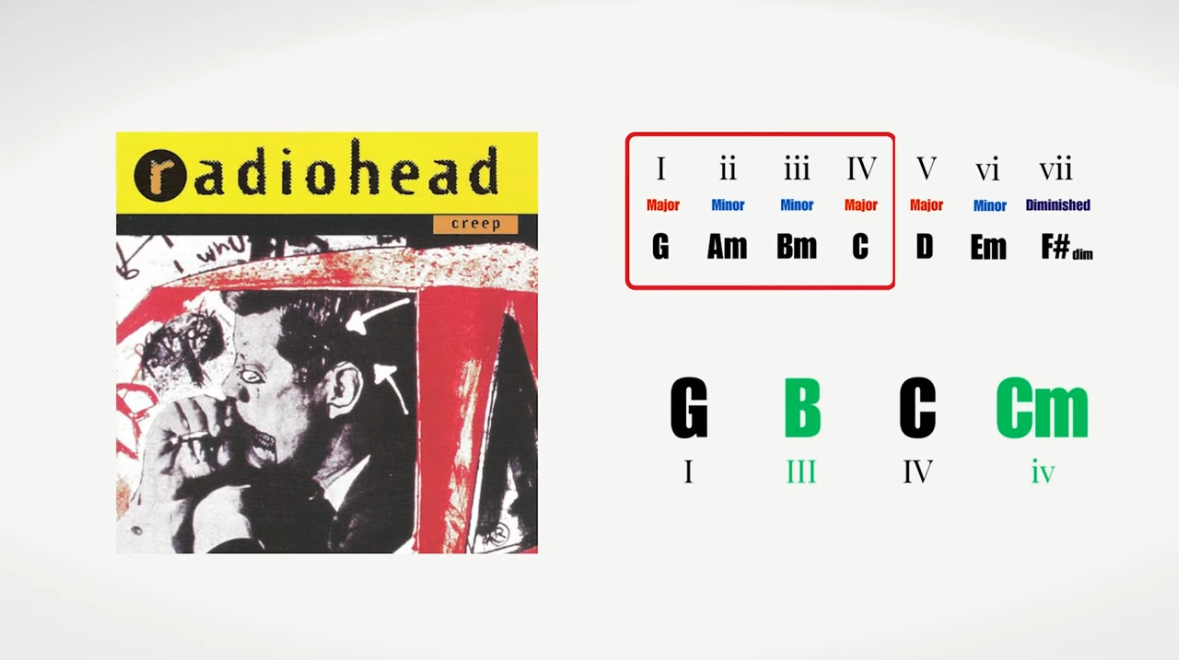
Another song that does this is “Creep” by Radiohead. However, instead of ending the progression with a major chord, they double up the IV chord and change it to a minor instead.
Applying Borrowed Chords to Songs
There are 3 main things to take into consideration when applying Borrowed Chords to your progressions.
- The order of your chords:
Since we listen to all of these chords in a sequence, changing the order of the chords changes the context of each individual chord. It changes the way we perceive each chord both in sound and function.
For example, the progressions C – F – Am – Gm and C – Gm – F – Am both have different qualities to them. A great exercise to practice is to pick a 4 chord sequence, then change one of those chords to a borrowed chord. After that, experiment with placing the borrowed chord at different points in the progression.
- The duration of your chords:
When we talk about the duration of your chords, we’re referring to how long each chord is held for. By changing the duration each chord is held, you can change the amount of tension and release in a progression.
For example, let’s take a look at the progression C – E7 – F – Am. If you hold E7 for twice as long as the other chords, you’ll cause the listener to experience a high amount of tension. This is because it calls the listener’s attention to the E7, and makes them anticipate a resolution.
- The inversions of your chords:
When you use different inversions of borrowed chords, you can create a smoother, more subtle sound. For example, playing E7 in an open position on the guitar is different from playing it as a barre chord.
Step 2 of Borrowed Chords: Create a New Chord
Aside from the 7 notes in a diatonic system, there are 5 other non-diatonic notes in the Western music system. We can do the same thing that we did to the chords in our diatonic system, and build chords using the 5 non-diatonic notes as bass notes.
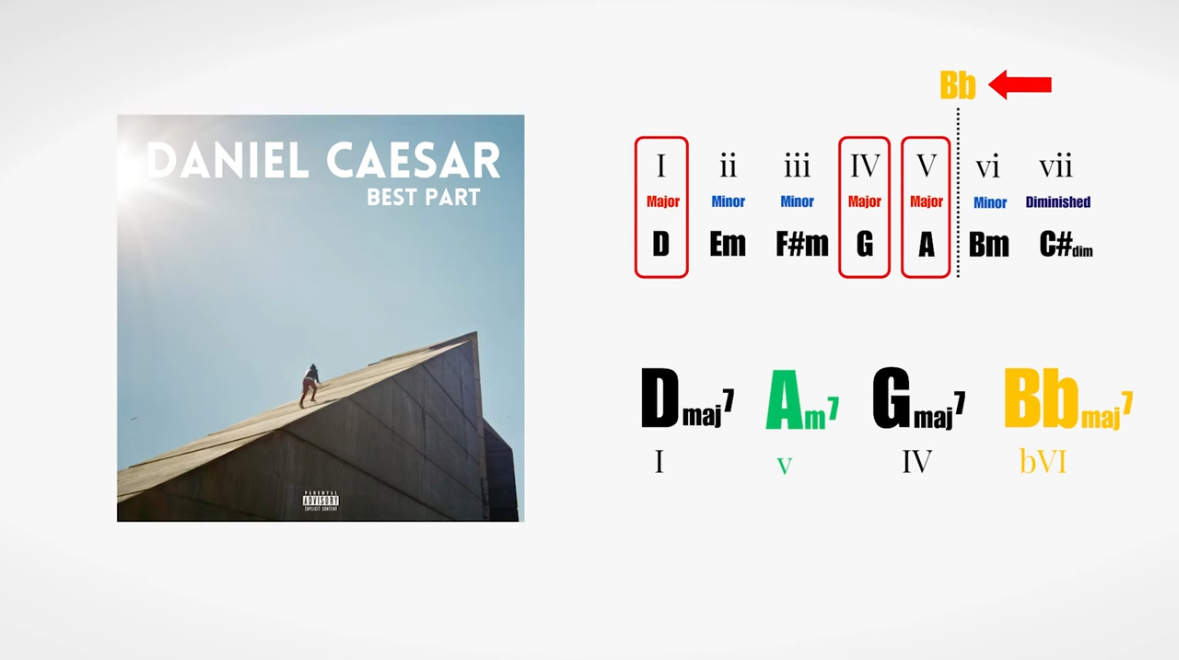
The song “Best Part” by Daniel Caesar is an example of a popular song that uses this method. The song goes from a D Maj7 to an A Min7 – which is a V chord where the quality has been changed to a Min7.
Then, it goes to a G Maj7, followed by a Bb Maj7 – which doesn’t exist in the key of D. This results in a beautiful sound that is commonly heard in gospel, and R&B music.
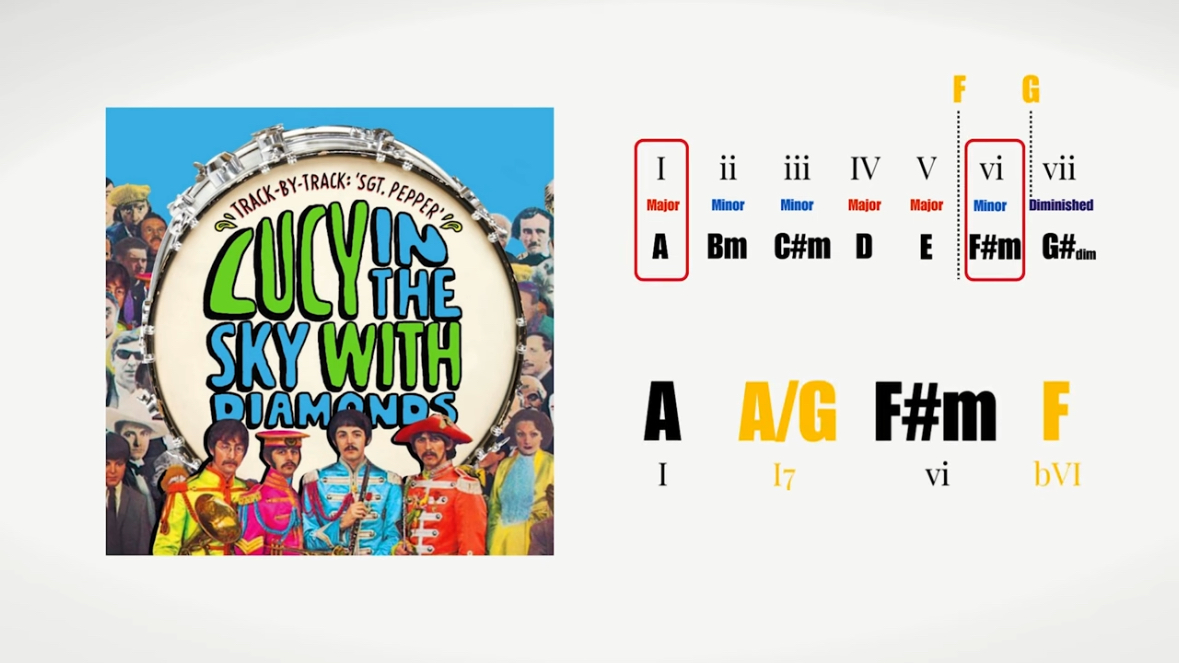
“Lucy in the Sky with Diamonds” by The Beatles also uses this technique in its chord progression. The A/G used in the verse progression creates a dominant sound since it’s essentially a one over flat six. In addition, the usage of a bVI at the end of the progression creates a nice chromatic bass line.
Creating Interesting Chord Progression
When we take a look at the 4 songs that we analysed, we can notice a pattern in the way the chord progression is formed. The progression always alternates between diatonic chords, and non-diatonic chords.
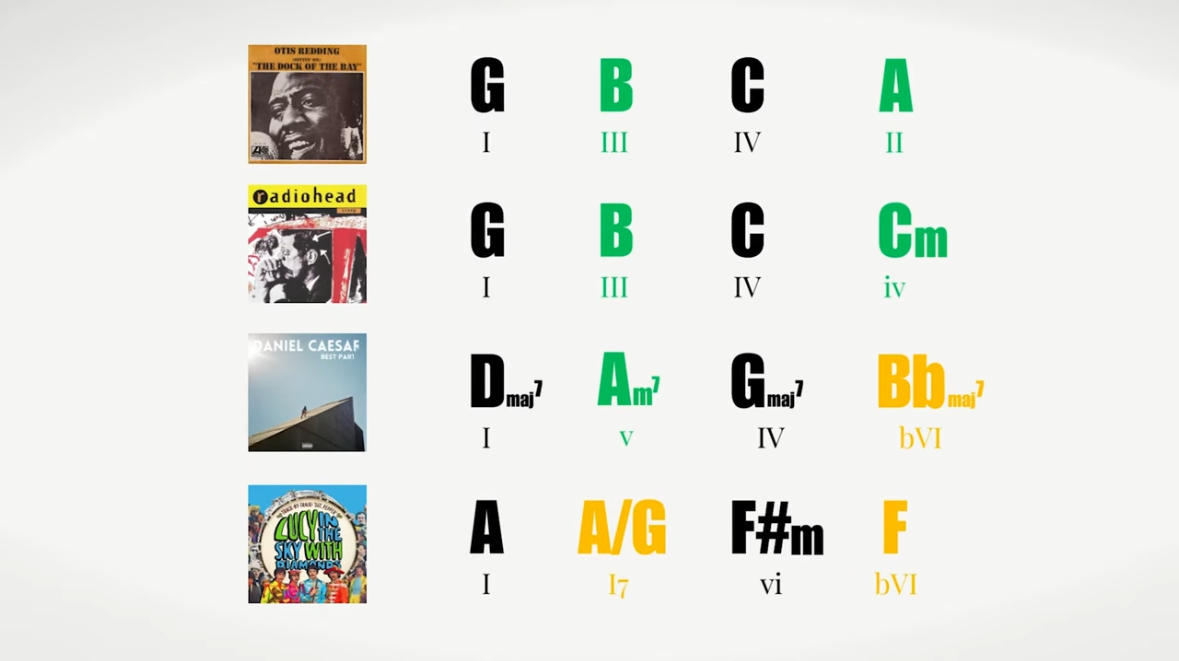
By applying this pattern to your own songs, you can create interesting chord progressions. In addition, you can experiment with inversions, chord duration, and chord order to create even more dynamic chord progressions. Below is an example of what that would look like:

Conclusion: The Magic of Borrowed Chords Explained
In conclusion, borrowed chords have the capability to make your chord progressions more interesting. Through experimenting with different arrangements, you too will be able to write chord progressions that maintain your listener’s interest like those in famous songs we know, and love.
If you would like more details, explanations and examples, then be sure to check out the video now.
